Stealer Logs: The Early-Warning System for Account Takeover
Infostealer logs expose corporate credentials and live session cookies days before account takeover. Learn how to triage stealer log alerts and act inside the 48-hour window.


Security teams once filed infostealer infections under help-desk nuisance. That classification has aged badly. In 2026, a stealer log is the most reliable advance notice most organisations will ever get that an account takeover is coming — if anyone is reading it.
What is inside a stealer log
A stealer log is the output of a single infected device. Infostealer malware such as Lumma, StealC, Vidar, RedLine or ACRStealer executes on an endpoint, sweeps local storage layers, exfiltrates, and exits, often in under a minute. The resulting package typically contains saved browser credentials, autofill data, cryptocurrency wallet files, system fingerprinting, and — the part that matters most — active session cookies and authentication tokens.
Those cookies are why multi-factor authentication is not a complete answer. A valid session token replays an already-authenticated session. The attacker never sees a password prompt, never triggers an MFA challenge, and never generates a failed login your SOC would notice.
This is not a fringe problem. Flare’s 2026 State of Enterprise Infostealer Exposure report found 2.05 million infostealer logs exposed enterprise identity credentials during 2025, with enterprise identity exposure rising from around 6 percent of logs in early 2024 to nearly 16 percent by 2026, and 79 percent of enterprise logs containing Microsoft-linked SSO
credentials. Roughly 1.17 million of those logs contained both credentials and live cookies. Flashpoint recorded 1.7 billion credentials harvested from 7.4 million hosts in the first half of 2026 alone.
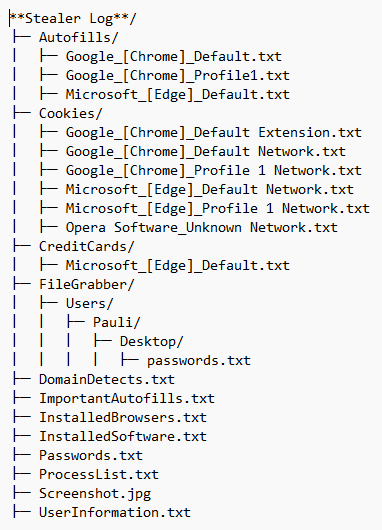
Figure 1: Example Anatomy of a stealer log entry.
Why stealer logs function as an early-warning signal
The value is in the lead time. Credentials commonly appear on markets and Telegram channels within hours of theft, and Verizon’s 2025 DBIR found the most common gap between a credential appearing in a stealer log and a ransomware incident was just two days. Constella reported that 78 percent of recently breached companies had corporate credentials appearing in infostealer logs within six months of the breach.
In other words, the exposure is observable before the intrusion. Credential leak monitoring frequently surfaces corporate VPN and email logins days or weeks before initial access broker activity is visible, giving defenders a chance to rotate and revoke before access is weaponised.
Recent examples of the pattern
The chain from infected laptop to enterprise incident is now well documented:
The 2024 Snowflake customer intrusions, attributed by Mandiant to UNC5537, used credentials previously harvested by infostealers, turning consumer-grade endpoint infections into large-scale cloud data theft and extortion.
A European airline breach followed the full sequence: VPN credentials obtained via infostealer malware, initial access to the corporate network, privilege escalation, then ransomware. MFA on VPN access was absent.
An FBI advisory documented a multimillion-dollar business email compromise traced to Raccoon Stealer infections, where stolen browser cookies allowed mailbox takeover without triggering authentication alerts.
Microsoft’s June 2026 research on StealC and the Amadey loader described logs from infected devices appearing on dark web markets within hours at USD 10–50 each, with premium corporate logs commanding more — and ReliaQuest observing Russian Market listings as low as USD 2.
Triage: not every log is an emergency
Treating all exposures as equal burns out teams and hides the real ones. Two questions establish severity: how fresh is the log, and what identity does it contain? A six-month-old consumer password for a retail site is noise. A log collected yesterday containing a corporate identity provider credential plus an authenticated browser session is an active incident.
A workable triage model:
Prioritise by identity value — SSO, IdP, VPN, cloud console, code repository and finance platform credentials first.
Prioritise by recency and by whether live session cookies are present alongside the credential.
Determine device ownership. Contractor, BYOD and unmanaged home devices sit outside EDR coverage and are the most common source.
Assume the whole device is compromised, not just the one credential that surfaced.
What to do inside the 48-hour window
When a high-risk exposure is confirmed, speed is the entire control. Invalidate every active session for the identity rather than only resetting the password. Reset the credential and any reused variants. Re-image or quarantine the source device. Then hunt for the behaviours that indicate exposure has already progressed to takeover: authentication from unexpected locations, access inconsistent with the user’s role, unusual bulk downloads, password-reset activity, and enrolment of new MFA devices.
The takeaway
Stealer logs are not just evidence of a past infection. They are a dated, specific, named forecast of the next account takeover attempt against your organisation. Continuous credential leak monitoring turns that forecast into hours of usable lead time, which is precisely the margin ransomware operators are counting on you not having.
Sinon Security monitors infostealer markets, Telegram channels and dark web forums for your corporate identities and delivers triaged, actionable exposure alerts. Contact us to see what is already circulating about your organisation.